


Filter by:
-
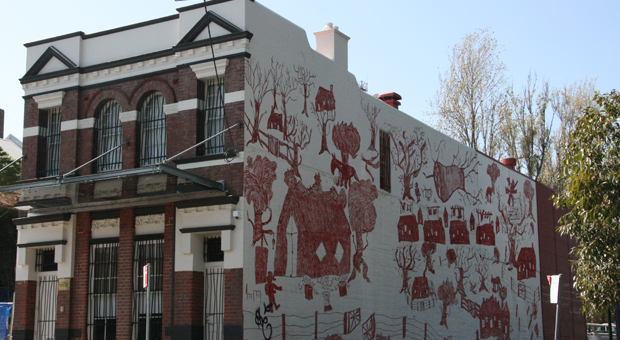
Wyanga Aboriginal Aged Care
Wyanga Aboriginal Aged Care was established by Sylvia Scott and Mary Silva in 1996 to provide a community aged care service for Aboriginal people in inner Sydney and La Perouse.…
-

The Edge of the Trees
This public artwork created by Fiona Foley and Janet Lawrence is located in the forecourt of the Museum of Sydney on the site of First Government House. The Edge of…
-
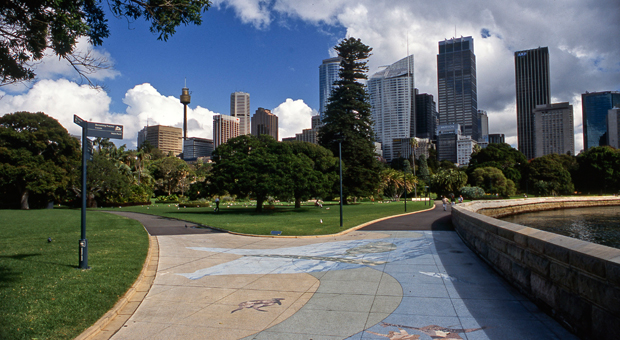
Wuganmagulya (Farm Cove)
Wuganmagulya (Farm Cove) is an art installation within the Royal Botanic Gardens which honours the original clans who lived on the site, as well as those who held ceremonies there.…
-

Yiribanna Gallery
The Art Gallery of NSW was established in 1884, but only acquired its first Aboriginal works in the mid-20th century. One of the gallery’s first collections of Aboriginal art was…
-

Burlington Hotel
Aboriginal people were not free to drink in public bars in Sydney through to the 1970s. Although not upheld by law, this informal apartheid was enforced by patrons, publicans and…
-

Boomalli
Boomalli is an artist-run cooperative which was formed in 1987 by a group of 10 urban Aboriginal artists working across a range of media from painting and photography to sculpture…
-

Black Theatre
Author: Lily Thomas-McKnight Black Theatre began informally in c1970 as a small group of Aboriginal people who came together to read scripts and poems. These reading groups soon expanded into…
-

Foundation for Aboriginal Affairs
The headquarters of the Foundation for Aboriginal Affairs on George Street was opened in October 1966. In addition to providing welfare support for Aboriginal people migrating to Sydney from regional…
-

Henry Jones IXL jam factory
Sydney has long been a magnet for Aboriginal and Torres Strait Islander people seeking work opportunities, shelter and connections with community and family. Many worked in private industry in Sydney’s…
-
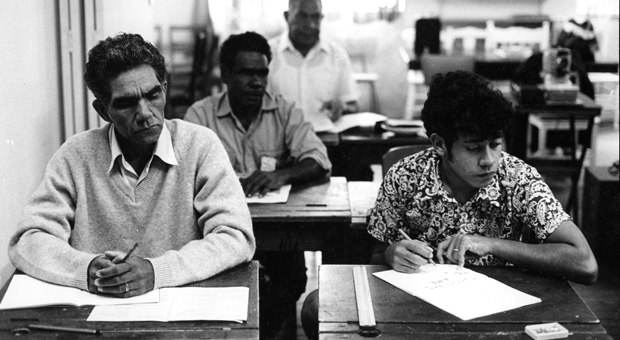
Tranby
Tranby Aboriginal College is a community-based education cooperative run by and for Aboriginal people. Located in the inner-city suburb of Glebe, Tranby has provided an independent learning environment for Aboriginal…
-

Aboriginal Housing Company
There has always been an Aboriginal presence in Redfern because it is centrally located, housing was once relatively cheap, and it was close to industry and jobs in South Sydney.…
-

NAIDOC Week in Sydney
NAIDOC Week had its foundations in Sydney just over 90 years ago. There was a growing political activism within Sydney’s Aboriginal community in the early 20th century. The formation of…
-

Australian Hall
This was where Aboriginal rights activist Jack Patten read the resolution on citizenship rights at the Day of Mourning Conference on 26 January 1938, which only Aboriginal people were allowed…
-

Bidura
Bidura was a grand residence designed and built as a family home by architect Edmund Blacket. It was purchased by the NSW Child Welfare Department in 1920 for use as…
-

Aborigines Welfare Board
The Chief Secretary’s Building on Macquarie Street was the meeting place for the now notorious Aborigines Welfare Board until the Board’s abolition in 1969. The organisation was formed in 1883…
-

Sydney Cove / Warrane
The Aboriginal name for Sydney Cove as recorded in a number of First Fleet journals, maps and vocabularies, was Warrane, also spelt as War-ran, Warrang and Wee-rong. This place is…
-
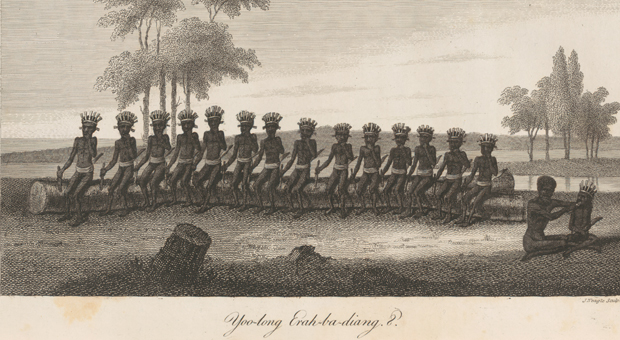
The Domain and Royal Botanic Gardens
Author: Paul Irish The Governor’s Domain has been a public space since the earliest days of the Sydney colony, and continued to be used for many years by Aboriginal people.…
-

The site of First Government House
Author: Paul Irish and Tamika Goward Sydney’s first Government House overlooking Sydney Cove was built for Governor Arthur Phillip in 1789. The building and its grounds were an important place…
-

Hyde Park South
Until the mid-1820s, Aboriginal people travelled from all over Sydney, and as far away as the Hunter and the Illawarra, to gather at a ceremonial contest ground to the south…
-

Australian Museum
The Australian Museum is Australia’s oldest natural history museum. It was established in 1827 when the British Colonial Office authorised a museum in NSW for the collection of ‘rare and…
-

Prince Alfred Park (Cleveland Paddocks)
Prince Alfred Park, earlier known as Cleveland Paddocks, was an Aboriginal camp site until the mid-19th century. Sydney’s Aboriginal people lived here, west of the city centre, until the coming…
-

Lake Northam
Blackwattle Creek was once a tidal watercourse that extended from its marshy headwaters at Glebe towards the suburbs of Redfern and Waterloo to the south. Lake Northam within Victoria Park…
-

Bennelong Point / Dubbagullee
Bennelong Point / Dubbagullee, the peninsula on the eastern side of Sydney Cove, was the site of a brick hut built for Bennelong by Governor Arthur Phillip in 1790. Within…
-

Lilyvale Campsite
Author: Paul Irish and Tamika Goward The Rocks area is mainly known as a place of early European history, but it was also used by Aboriginal people for many years…
-

Sheas Creek (Alexandra Canal) Alexandria
Author: Paul Irish and Tamika Goward At Beaconsfield in the 1890s, workers on the Alexandra Canal began cutting through the sediments of Shea’s Creek and made some remarkable discoveries. The…