



Filter by:
-

1967 Referendum
Author: Danika Davis When Aboriginal-Australian Fellowship (AAF) activists filled Sydney Town Hall for their first meeting on 29 April 1957, they set off a series of actions that led to…
-

Koiki: the Mabo star
Author: Danika Davis Australian people observe Mabo Day on 3 June each year to commemorate Eddie Mabo’s courage and determination to overturn the fiction of terra nullius, recognising that First…
-

Apology To The Stolen Generations
On 13 February 2008, former Prime Minister Kevin Rudd delivered a formal apology to Australia’s Aboriginal and Torres Strait Islander peoples, with specific reference to the Stolen Generations, at Parliament…
-

Aborigines Protection Board Office
Author: Paul Irish An unassuming terrace house once located at the back of the State Library of NSW was home to the Aborigines Protection Board (APB) at the peak of…
-

Speakers’ Corner at The Domain
Author: Paul Irish Speakers’ Corner was established in the eastern end of The Domain near the Art Gallery of NSW in 1878. Aboriginal speakers were active there from the late…
-

Mrs Macquarie’s Chair
Author: Paul Irish In January 1988, an Aboriginal Tent Embassy was set up at Mrs Macquarie’s Chair (at Mrs Macquaries Point / Yurong) in protest against the planned bicentennial celebrations…
-

Reconciliation Park
Reconciliation is the symbolic recognition of the honoured place of the First Australians in our society. The movement for reconciliation between Aboriginal and Torres Strait Islander peoples and the wider…
-

NYE Welcome to Country illuminations
On New Years Eve 2015, a specially choreographed Welcome to Country was projected on to the pylons of Sydney Harbour Bridge, making the entire structure a message of hope for…
-

Recognising military service
Author: Catherine Freyne On National Aborigines’ Day in July 1969, a crowd of about 400 people gathered in Hyde Park south and watched as two Aboriginal children laid wreathes on…
-

Douglas Grant
Author: Nicole Cama Douglas Grant was a natural born leader, fiercely intelligent artist and poetry enthusiast who served as a Private in the 13th Battalion of the Australian Imperial Force…
-

Military service and Aboriginal voices
Author: Catherine Freyne The City of Sydney’s history team started recording oral histories with Aboriginal and Torres Strait Islander service people in 2008. The project gained new impetus in 2013…
-
Bert Groves
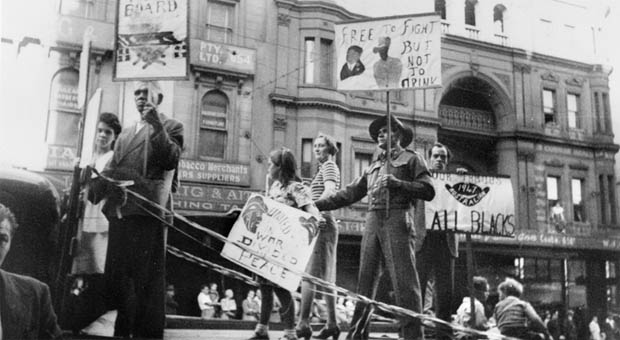
Author: Laila Ellmoos Bert Groves was an active and vocal Sydney-based Aboriginal activist in the 1950s and 60s, who improved the lives of Aboriginal and Torres Strait Islander peoples across Australia.…
-

Aboriginal organisations in Sydney
Author: Anita Heiss Aborigines Progressive Association (APA) The Australian Aborigines Progressive Association (AAPA), led by Fred Maynard, operated in Sydney from 1924 to 1927 when it was disbanded due to…
-

Significant Aboriginal people in Sydney
Author: Anita Heiss Arabanoo In December 1788, not long after the landing of the First Fleet, Governor Phillip ordered the capture of Arabanoo (born c1758). Arabanoo was dressed in European…
-

Jack Patten
John (Jack) Patten was a public speaker and William Ferguson’s collaborator in the early days of the Aborigines Progressive Association (APA). He was born in Cummeragunja on the Murray River;…
-

Significant Aboriginal events in Sydney
Author: Anita Heiss January 26 was nominated as Australia Day to celebrate the anniversary of white settlement. It commemorates the ceremonious unfurling of the British flag at the head of…
-

Government policy in relation to Aboriginal people
Author: Anita Heiss Since the European invasion until very recently, government policy relating to Aboriginal people has been designed and implemented by non-Aboriginal people. The common justification for most policies…
-

Charles ‘Chicka’ Dixon
Charles ‘Chicka’ Dixon was born at Wallaga Lake and worked as a stevedore on Sydney’s wharves. He worked in the Seamen’s Union as a shop steward before following the political…
-

Charles Perkins
Born on the Todd River in Alice Springs, Charles Perkins moved to Adelaide in 1945. Spotted by a soccer talent scout, he played for Everton in England and returned after…
-

Aboriginal involvement with the church
Author: Anita Heiss Much of the early interest in Sydney’s Aboriginal people was as a study of ‘primitives’ in need of salvation. Catholic priests, Fathers Therry and Power baptised around…
-
Foundation for Aboriginal Affairs
The Foundation for Aboriginal Affairs was established in December 1964 to provide assistance to Aboriginal people living in Sydney. Although it was originally intended as a non-political and non-religious organisation,…
-

Royleston
Royleston was a grand Glebe residence built in 1880. It was purchased by the NSW Child Welfare Department in 1922 for use as a ‘home’ or ‘receiving depot’ for male…
-

Redfern Park
Redfern Park was the site of a speech given by the former Australian Prime Minister Paul Keating on 10 December 1992, to launch the Year of the Indigenous Person. Subsequently…
-

Land Rights
Along with the protection of children, and the right to vote and be counted, Aboriginal people also mobilised politically around land rights throughout the 20th century. Sydney had seen protests…
-
Freedom Ride
The decade of the 1960s was a time of protest against racism around the world. In 1965, Sydney University student and Arrente/Kalkadoon man Charles Perkins joined with university students and…