



Author: Lily Thomas-McKnight
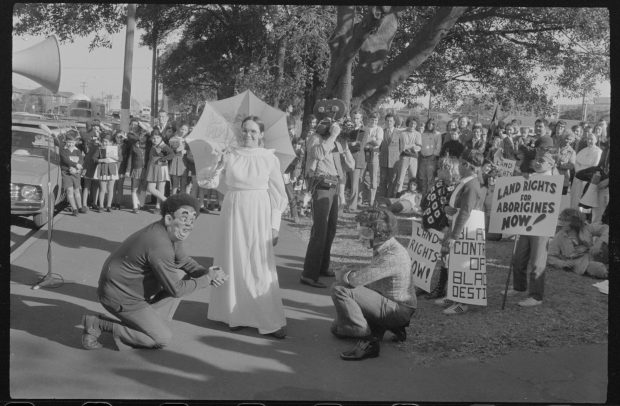
Black Theatre began informally in c1970 as a small group of Aboriginal people who came together to read scripts and poems. These reading groups soon expanded into street performances that exposed police violence against Aboriginal peoples and the everyday racism experienced by urban and rural Aboriginal people. Some of the Aboriginal activists involved included Aileen Louise Corpus, Zac Martin, Gary Foley, Bindi Williams, Robert ‘Bob’ Maza, Paul Coe, Lyn Thompson, Gerry Bostock, and Lester Bostock.
In 1972 the Black Theatre invited Yidinjdji and Meriam actor, playwriter and activist, Robert ‘Bob’ Maza (1939–2000) from Melbourne, to join the group to gain more professional experience in the performing arts. Two years prior, Maza had visited America at the invitation of Roosevelt Brown, and attended the Pan African Congress in Atlanta, Georgia, and visited the National Black Theatre in Harlem, New York. In Sydney, Maza took the role of the theatre’s director and was keen to explore the possibilities of theatre as a political tool (Johanna Perheentupa, 2020, p. 100).
Black Theatre was driven by the Black Power and Aboriginal self-determination movements in Australia and the United States. African Canadian-American actor and director Lloyd Richards stated that the “American experience indicated that the Aboriginal theatre movement would confront problems because it would express sentiments that the majority did not want to hear”. Richards also stated the importance of theatre for minority groups to retain their identity (Gary Foley, The Koori Website Project). Through street performances, Black Theatre showcased experiences of police brutality that the white public often ignored.
The first permanent location for the Black Theatre was at 181 Regent Street, Redfern. The building was a double story sandstone terrace across the road from the Aboriginal Legal Service and a few doors up from the Aboriginal Medical Service. Despite being different organisations, individuals and ideologies crossed over in each institution. The building was used as offices and for classes, but it was also a place to live for some of the theatre’s members, including Maza and his family. Maza’s daughter Rachel Maza recalls that the building was an environment of intellectual discourse (Perheentupa, 2020, pp. 101-102).
Bronwyn Penrith recounts that most of the actors, including herself, had never acted before other than acting to survive racism (Bronwyn Penrith, 2025). One of Black Theatre’s first performances, The Challenge – Embassy Dance, was at the re-erection of the Tent Embassy in Canberra on 30 July 1972. This re-erection was a response to the Embassy’s forced and violent removal. One of Black Theatre’s main concerns was police brutality because many of its members had been arrested on the way to performances. One street performance depicted Gary Williams being arrested by two non-Aboriginal actors pretending to be police. A lawyer who witnessed this performance called the local police station, demanding for William’s release from custody, believing the act was real (Perheentupa, p. 103). These types of performances aimed to educate audiences on the everyday lived experiences of Aboriginal people in Sydney and across Australia.
Along with street performances, the Black Theatre performed in theatres, most notably Nimrod Theatre in Kings Cross, Sydney. One performance was the comedy skit Basically Black (1972). Using humour, Basically Black criticised White Australia and brought forth the real and everyday Aboriginal experiences with police brutality, malnutrition and land rights. Basically Black was picked up by the ABC as a television show but was cancelled due to its provocative nature which was uncomfortable for some white Australians. Many scenes for the skits were filmed at 181 Regent Street (City of Sydney Archives, 181/183 Regent St Redfern, p. 20). Nimrod Theatre featured other performances by Black Theatre including The Cake Man (1975) and Here Comes the N***** (1976). These performances in the 1970s paved the way for future Aboriginal theatre and performance companies and productions, including Bangarra and Black Comedy.
The Black Theatre hosted drama workshops for around 40 adults and 20 children. African-American dancer Carole Johnson bought dance classes to the theatre including jazz and ballet. These workshops gave Aboriginal peoples an opportunity to train in the performing arts and fostered a shared powerful identity. As Paul Coe noted:
It’s only when we find an identity, as a group, as a race, and only until then can we possibly sort of mobilize action on the scale which I think could change this country for the better. (Paul Coe on Monday Conference broadcast, ABC, March 1972, cited in Perheentupa, 2020, p. 102).
The Black Theatre also functioned as a community centre frequented by Aboriginal communities and organisations including the Aboriginal Legal Service. Black Theatre relocated to 31-33 Cope Street (formally Botany Street) in 1974 in a hall leased from the Methodist Church (Redfern Oral History).
Although the Black Theatre closed its doors in 1977, it laid the foundation for creative Aboriginal expression in Sydney and across Australia.
About the Author
Lily Thomas-McKnight is a proud Wiradjuri and Gomeroi woman with ties to Yuin Country.
Further reading
Books and reports
Gordon Briscoe, Lester Bostock and Rosalee Quinlan, ‘Dispossession, protection and sovereignty: a history of significant Indigenous heritage sites’ (2003), City of Sydney Archives, LIB-00013203, https://archives.cityofsydney.nsw.gov.au/nodes/view/1750307.
Johanna Perheentupa, Redfern: ‘Aboriginal activism in the 1970s’ (Canberra, ACT: Aboriginal Studies Press, 2020).
Johanna Perheentupa, ‘To be part of an Aboriginal dream of self-determination: Aboriginal activism in Redfern in the 1970s’ (PhD Thesis, University of New South Wales, 2013), http://hdl.handle.net/1959.4/53187.
Articles
‘Black Theatre 1972–1977’, Redfern Oral History, http://redfernoralhistory.org/enterprises/blacktheatre/tabid/204/default.aspx.
Katharine Brisbane, ‘The Future in Black and white: Aboriginality in Recent Australian Drama’, 27 June 2022, https://kooriweb.org/foley/images/history/1970s/blacktheatre/the%20future%20in%20black%20and%20white.pdf.
Anna Cole and Wendy Lewis, ‘Fisher, Bettie (1939–1976)’, Australian Dictionary of Biography, National Centre of Biography, Australian National University, https://adb.anu.edu.au/biography/fisher-bettie-10187/text18001, published first in hardcopy 1996, accessed online 12 December 2025.
Steve Dow, ‘It Had No Filters: The Legacy of Australia’s Provocative National Black Theatre’, The Guardian, 10 November 2022, www.theguardian.com/stage/2022/nov/09/it-had-no-filters-the-legacy-of-australias-provocative-national-black-theatre.
Gary Foley, ‘Black Power in Redfern 1968–1972’, 5 October 2001, https://kooriweb.org/foley/essays/essays_page.html.
Gary Foley, ‘The Development of Black Theatre During the 1970s’, The Koori History Website Project, https://kooriweb.org/foley/images/history/1970s/blacktheatre/nbtdx.html.
Gary Foley, ‘The 1970s Black Theatre History’, The Koori History Website Project, https://webarchive.nla.gov.au/awa/20040307231923/http://pandora.nla.gov.au/pan/15182/20210127-0000/www.kooriweb.org/foley/images/history/1970s/blacktheatre/article4.htm.
‘The 1967 Referendum’, AIATSIS, 21 January 2021, https://aiatsis.gov.au/explore/1967-referendum.
Zoe Pollock, ‘National Black Theatre’, Dictionary of Sydney, 2008, https://dictionaryofsydney.org/entry/national_black_theatre.
Film and oral histories
Aunty Bronwyn Penrith, interviewed by Sue Andersen and Dallas Wellington, 5 August 2025, City of Sydney History Team oral history collection.
‘The Redfern Story’, (2014), City of Sydney Archives, LIB-00020401, https://archives.cityofsydney.nsw.gov.au/nodes/view/1983303.
Archives
‘181/183 Regent St Redfern’, City of Sydney Archives, A-00463271, https://archives.cityofsydney.nsw.gov.au/nodes/view/999893#idx3664226.